 blog
Graphene Cream for Arthritis Pain: What Works in 2026
Table of Contents
- Graphene Cream for Arthritis Pain: What It Is and How It Works
- What Graphene Cream Reviews Actually Tell You
- Topical Diclofenac for Arthritis Pain: The Established Option
- Graphene Topical Cream Safety: What to Check Before You Buy
- How to Apply Arthritis Cream for Best Results
- Other Topical Options for Joint Pain and Stiffness
- Conclusion: Setting Realistic Expectations
- Frequently Asked Questions
Last Updated: October 12, 2026
Graphene Cream for Arthritis Pain: What It Is and How It Works
Graphene cream for arthritis pain is a topical product that uses carbon-based graphene particles to deliver warmth and support to joints affected by osteoarthritis and everyday stiffness.
The core idea is simple. Graphene is a one-atom-thick sheet of carbon with high thermal conductivity, which is why formulators use it in heating films and wearable heat patches. In a topical cream, the goal is a warming effect plus a physical structure that sits on the skin.
Graphene vs. Graphene Oxide: Why the Type Matters
Not all graphene is the same material, and this distinction decides whether a cream is worth buying. Pristine graphene is a clean carbon sheet.
The National Institute of Environmental Health Sciences guidance on nanomaterials notes that nanomaterial safety depends heavily on particle form and processing. That is the practical reason we disclose our material type openly.
For buyers, the check is straightforward:
- Look for "pristine" or "large-flake" graphene on the label
- Look for a layer count, such as 1-5 layers
- Be cautious of vague "graphene-infused" claims with no material detail
A cream built on graphene oxide is a different product from one built on pristine graphene. Treat them as separate categories.
What Graphene Cream Reviews Actually Tell You
Reviews of graphene creams cluster around three themes: warmth, ease of application, and how the product feels on skin. Few reviewers report dramatic overnight changes, and the honest ones describe gradual comfort over consistent use.
But reviews alone cannot tell you whether the product you are reading about is even the category you think it is. This is the single biggest blind spot in the graphene cream market, and it is where most buyers get burned.
The Verification Problem: Cream vs. Heating Device
A large share of search results for "graphene" and joint pain are not creams at all. They are graphene heating films, wearable heat patches, far-infrared wraps, and heated knee sleeves. These are legitimate products, but they work through sustained heat delivery from a powered or exothermic device, not through a cream rubbed into skin.
A practical checklist before you trust any graphene cream review or listing:
- Is the product described as a cream, lotion, gel, or balm, or as a patch, wrap, sleeve, or device?
- Does the ingredient list name graphene, graphene oxide, or a graphene derivative, or does it only appear in the marketing copy?
- Is the graphene type stated (pristine vs. graphene oxide) and is a layer count given?
- Is there a full ingredient list with preservatives, fragrances, and dyes disclosed?
- Does the seller describe a mechanism (warming, skin contact) rather than implying drug-like pain blocking?
- Is there a stated return policy if your skin reacts?
If a listing fails three or more of these, treat the reviews as unverifiable. You cannot evaluate a product you cannot identify.
What a Credible Review Actually Contains
When you read reviews, filter for specifics:
- Does the reviewer name the joint and the condition (knee osteoarthritis, hand stiffness, post-activity soreness)?
- Do they mention how long they used it before judging, days, weeks, a month?
- Do they describe texture, scent, absorption time, and whether it stained clothing or bedding?
- Do they mention any skin reaction, and how quickly it appeared?
Reviews that skip all four tell you almost nothing. Reviews that describe a knee, a timeline, a texture, and a reaction give you something to compare against your own situation.
The most common complaint across topical pain products is not ineffectiveness. It is irritation from fragrances, dyes, and preservatives. That is why dye-free, fragrance-light formulations tend to generate fewer negative reviews even when their active warming effect is modest.
Topical Diclofenac for Arthritis Pain: The Established Option
Topical diclofenac is the most studied over-the-counter topical for arthritis pain, and it works differently from graphene. It is a nonsteroidal anti-inflammatory drug, or NSAID, that reduces inflammation in the tissue under the skin.
The FDA information on topical diclofenac products describes these as approved pain relievers for joints like the knees and hands. If your goal is reducing inflammation, this is the category with the clearest regulatory footing.
How Diclofenac Compares to Graphene Topicals
Diclofenac and graphene creams are not competitors so much as different tools. Diclofenac targets inflammation through a drug pathway. Graphene topicals target comfort through warmth and skin support, with no drug ingredient.
| Feature | Topical Diclofenac | Graphene Topical Cream |
|---|---|---|
| Mechanism | NSAID, reduces inflammation | Warming, skin contact support |
| Regulatory status | FDA-approved OTC drug | Cosmetic or general topical |
| Best for | Inflamed, swollen joints | Stiffness, daily comfort, mobility |
| Main caution | NSAID interactions | Verify material type and purity |
| Typical use | 2-4 times daily, per label | Daily, as part of a routine |
If you take blood thinners, have kidney issues, or use oral NSAIDs, talk to your doctor before adding topical diclofenac. That is not a small caveat.
Graphene Topical Cream Safety: What to Check Before You Buy
Safety for graphene topicals comes down to four things: material purity, ingredient list, skin condition, and what else you are putting in or on your body.
For material purity and ingredients, demand transparency. The National Institute of Environmental Health Sciences guidance on nanomaterials notes that nanomaterial safety depends heavily on particle form and processing, which is the practical reason material disclosure matters more here than in a conventional lotion.
Skin Reactions and When to Stop
Topical reactions follow a predictable pattern. Watch for these within the first 24 to 48 hours:
- Redness, warmth, or a raised rash at the application site
- Itching that starts after application and does not fade within an hour
- Burning or stinging beyond the expected warming sensation
- Blistering, weeping, or swelling, stop immediately and seek care
If you have eczema, psoriasis, rosacea, or generally sensitive skin, introduce any new topical slowly. One application to a small area, then wait a full day before applying again. Do not apply to broken, sunburned, or irritated skin, and do not cover the area with an airtight bandage or heating pad immediately after application, since occlusion increases absorption and irritation risk.
Medication Interactions and Who Should Ask a Clinician First
Graphene topicals are not drugs, so they do not carry the systemic interaction profile of an NSAID. But the practical risk is different: people often layer a graphene cream on top of, or alongside, a medicated topical. If you are already using topical diclofenac, a prescription topical NSAID, a lidocaine patch, or a capsaicin product, do not stack them on the same joint without asking a pharmacist or clinician.
Talk to a clinician before using any new topical if you:
- Take blood thinners or have a bleeding disorder
- Have kidney, liver, or heart conditions
- Are pregnant, planning to become pregnant, or breastfeeding
- Are managing pain in a child or adolescent, topical pain products are not dosed the same way for younger skin
- Have diabetes with reduced sensation in the feet or hands, since you may not feel a reaction developing
- Have a history of contact dermatitis or adhesive allergies
The Verification Checklist Before You Buy
Check for these before purchasing:
- Graphene type stated as pristine or large-flake, or graphene oxide disclosed as such
- Layer count listed, such as 1-5 layers
- Full ingredient list, including preservatives, fragrances, and dyes
- Dye-free and fragrance-light where possible
- Clear return policy if your skin reacts
- Seller contact information and a physical business address
- No claims of curing arthritis, reversing joint damage, or replacing prescribed medication
When to Stop Self-Treating and See a Clinician
Topical comfort products have a role in daily joint care, but they are not a substitute for evaluation. See a clinician if joint pain is accompanied by swelling that does not improve, redness and warmth that suggest infection, pain that wakes you at night, loss of range of motion, or symptoms lasting more than a few weeks despite consistent topical use. Persistent or worsening pain needs a diagnosis, not another cream.
How to Apply Arthritis Cream for Best Results
Application technique changes results more than most people expect. Clean skin, a small amount, and a full minute of gentle massage is the routine that works.
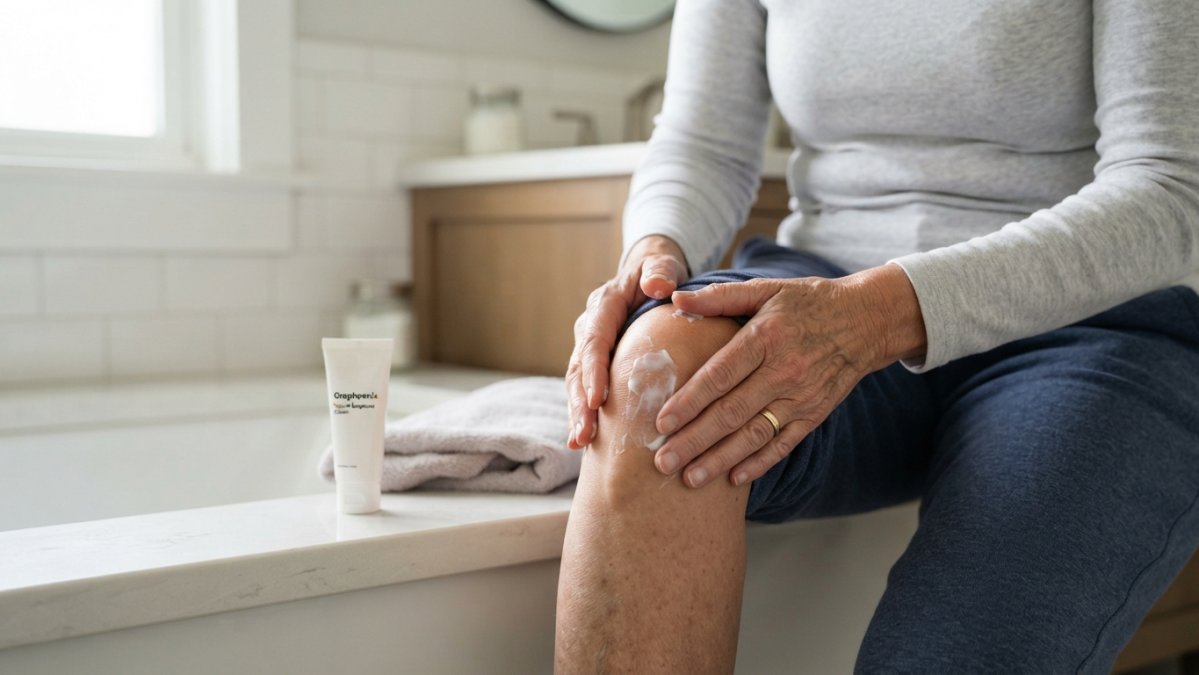
Here is the sequence we recommend:
- Wash and dry the affected area completely
- Dispense a pea-sized amount, more for larger joints
- Massage in circles for 60 seconds until absorbed
- Wash your hands unless treating your hands
- Reapply according to the label, usually 2-3 times daily
Consistency beats intensity. A cream used twice a day for two weeks tells you more than three applications in one afternoon.
Other Topical Options for Joint Pain and Stiffness
Beyond diclofenac and graphene, several counterirritants have long track records for minor arthritis pain. These include menthol, capsaicin, salicylates, and botanical ingredients like arnica.
Each works differently:
- Menthol creates a cooling sensation that distracts from pain signals
- Capsaicin uses heat to desensitize nerve endings over repeated use
- Salicylates are related to aspirin and act as mild analgesics
- Arnica is a plant extract used for soreness and bruising
Capsaicin requires commitment. It often stings for the first week before benefits appear, and you must wash your hands carefully after applying it.
Many people rotate formats, using a gel in the morning for fast absorption and a cream at night for longer contact. Gel formulations feel lighter and dry quickly.
Conclusion: Setting Realistic Expectations
Graphene topicals are a comfort and mobility tool, not a cure for osteoarthritis. Used daily alongside movement, heat, and your doctor's guidance, they can earn a place in your routine. If you want a topical built on disclosed, pristine large-flake graphene rather than an unlabeled blend, that is exactly what we make. Graphoenix LLC offers topical creams designed to support itching, pain, and mobility, with a material specification published openly.
Frequently Asked Questions
Can graphene cream help with arthritis pain?
Graphene cream is a newer topical option, and research on it for arthritis is still limited. Some early studies suggest graphene-based materials may support heat retention or cellular activity, but there is no large clinical trial proving it reduces arthritis pain the way established ingredients like diclofenac do. If you try a graphene cream for arthritis pain, treat it as a complementary option and track your symptoms for a few weeks before deciding whether it helps.
Is graphene topical cream safe to use on skin?
Safety depends on the type of graphene used. Pristine graphene, made of 1-5 layers, is different from graphene oxide, which has been linked to potential toxicity in some lab studies. Before buying, check that the product specifies large-flake pristine graphene and avoids graphene oxide. Do a small patch test on your inner arm for 24 hours. If you have eczema, sensitive skin, or open wounds, ask your doctor first.
How long does arthritis cream take to work?
Most topical pain relievers, including diclofenac and menthol-based creams, start working within 30 minutes to a few hours. Graphene creams may take longer since the mechanism is different and less studied. Some users report gradual relief over one to two weeks of consistent use. If you feel no change after two weeks, it may not be the right option for your joint symptoms.
How do you apply topical cream for arthritis pain?
Wash and dry the affected area first. Apply a thin layer of cream, about the size of a pea for small joints or a nickel for larger ones, and massage it in gently until absorbed. Wash your hands afterward unless your hands are the treated area. Use it two to three times daily, or as directed on the label. Avoid wrapping the area tightly or using a heating pad over the cream unless the product instructions allow it.